
IAA Borehole analysis
Project Outline
There is a urgent unmet need for open access, systematic geomechanical information for the UK subsurface. This includes estimates of rock stresses (vertical and horizontal), and fluid pressures. The raw data needed to generate this information are available from a number of sources including the North Sea Transition Authority (NSTA) National Data Repository (NDR).
The current knowledge gap impedes progress on the Energy Transition because the risks are so poorly constrained. We have produced workflows and tools to calculate rock stress and fluid pressure using published ‘industry standard’ methods from the public open well data in the NDR, including estimates of uncertainty.
We will map these values across the offshore UKCS and onshore UK, and plot stress-depth profiles for any specific well locations. This will open up interpolation between well locations to estimate stresses and pressures using spatial statistics.
Quantification of the uncertainty in stress will enable better decision making – for costs and for safety – by all organisations looking to use the subsurface for the Energy Transition. In addition, it will provide stress and pressure estimates significant volumes of continental crust, and useful to academic geoscientists and engineers.
CEMAC activity
NSTA ( https://www.nstauthority.co.uk/ ) holds records for thousands of wells drilled in the North Sea and Irish Sea (> 13000). They start in the 1960s and contain information that can be processed to provide stress-depth profiles useful to inform carbon storage planning.
CEMAC provides the infrastructure for interrogating the NSTA database (using their API) and calculating the derived stresses to produce a standard set of plots. This consists of a web portal where a user selects the wells of interest and enters them into a job list.
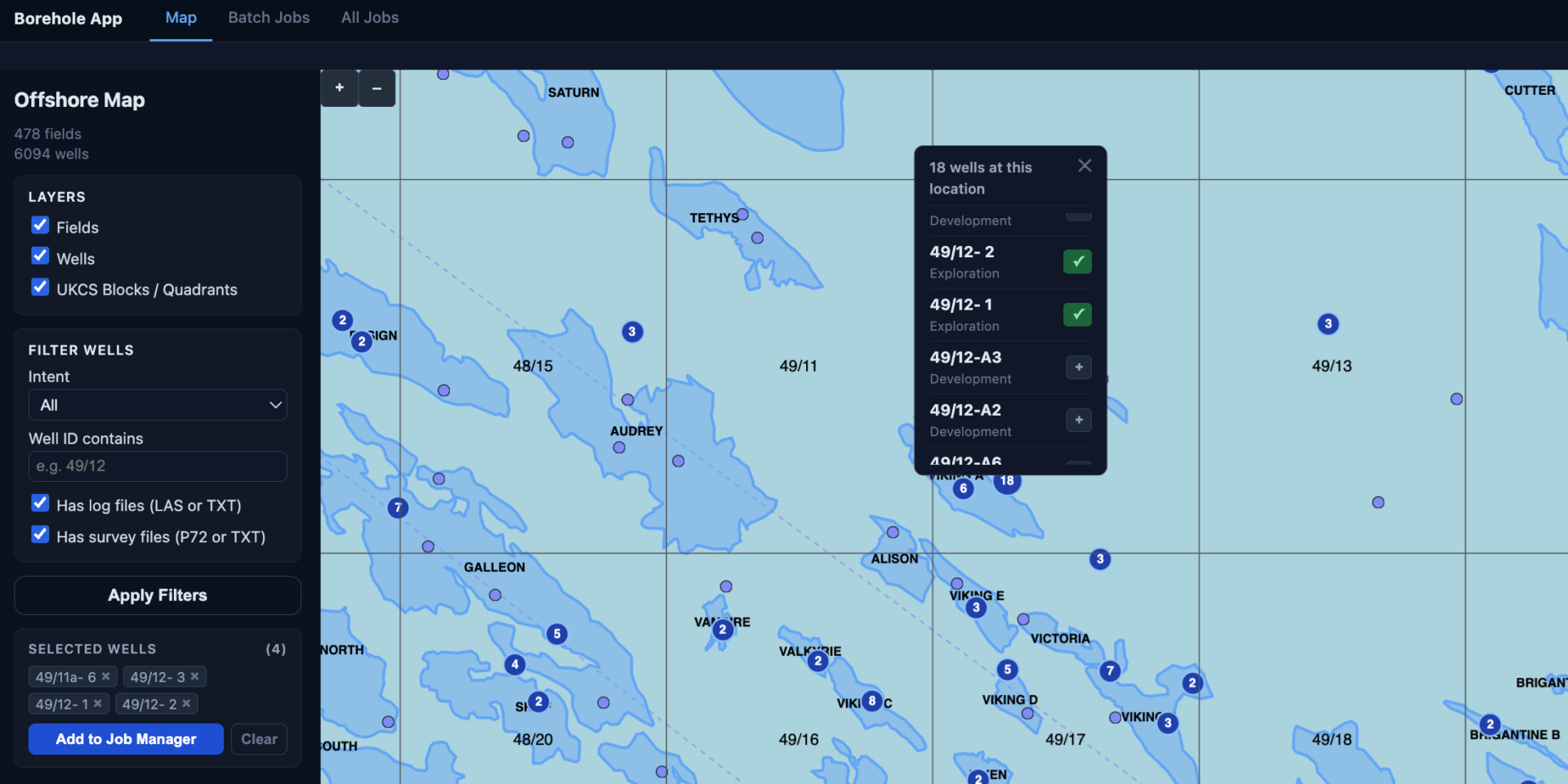
Web map allowing selection of offshore wells.
The wells that are selected are added to a job list. For each well, the NSTA's API is interrogated to retrieve metadata about relevant data files: joined well logs and deviation surveys. Within the web app, the user can download and inspect the data files, and select which ones to use for analysis. Once the jobs are configured they are submitted for processing.
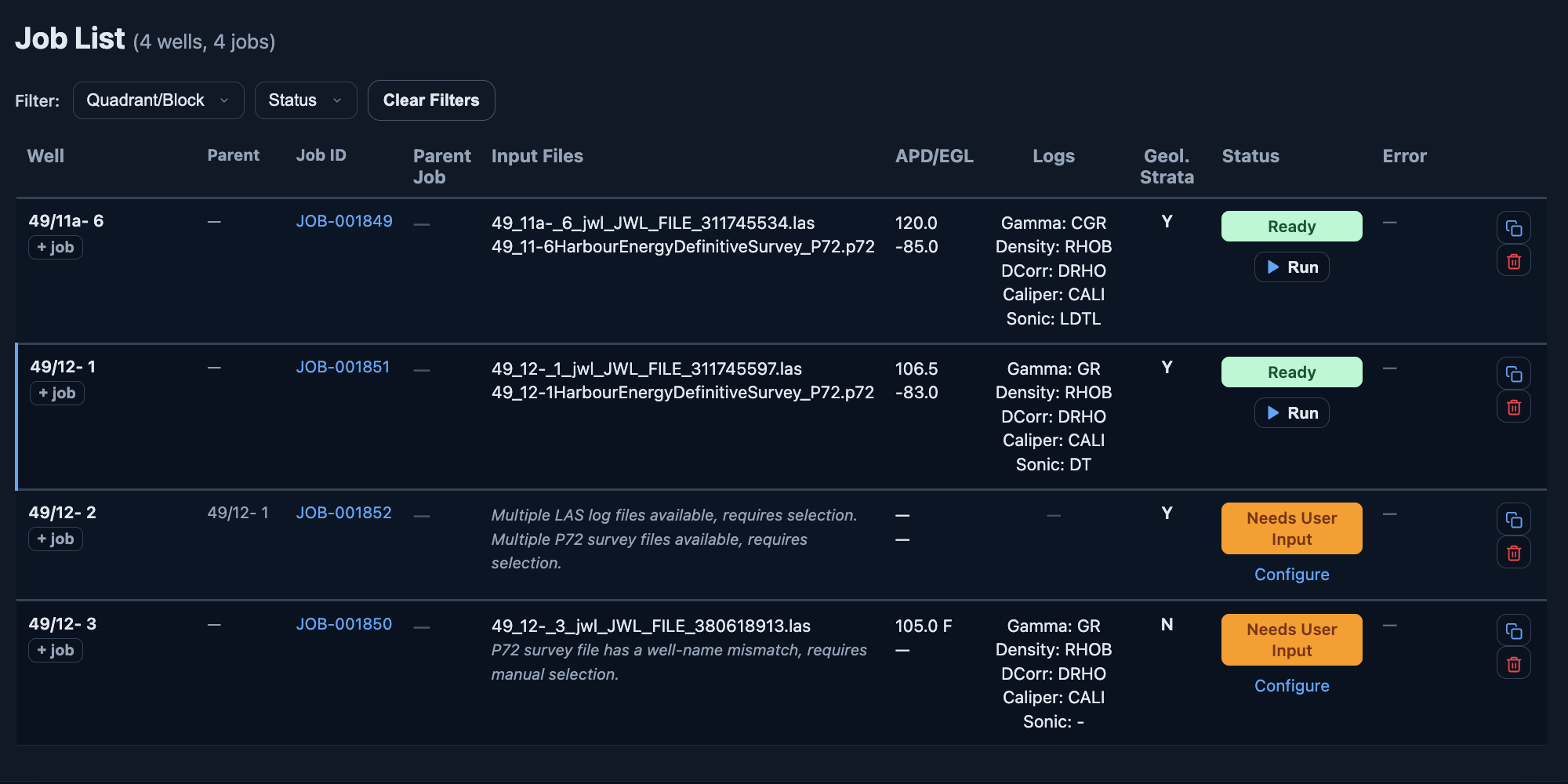
The web app contains a list of borehole jobs being configured for processing.
Each job calls the borehole processor to read the well data, fill in gaps in the density profile and calculate vertical stress. This produces various plots, including the age and lithology profiles, the calculated density profiles and the vertical stress profiles.

Profiles of ages (left) overlaid with original smoothed density profile (RHOB) and lithology (right) overlaid with original smoothed Gamma and Sonic (DT) for one of the Viking A wells
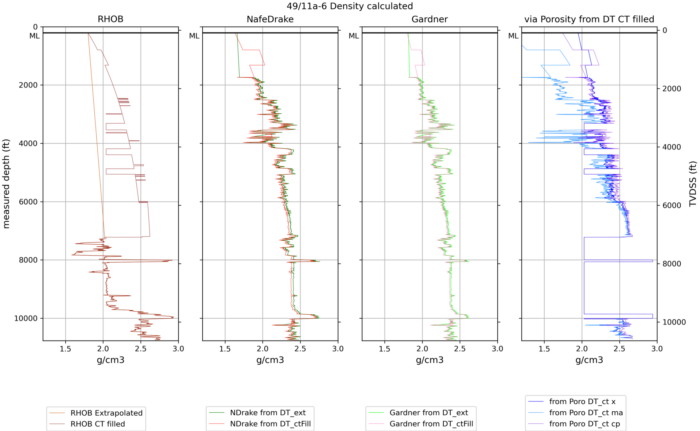
Density for one of the Viking A wells calculated using different methods based on compaction trends for different lithologies or on Sonic (DT)
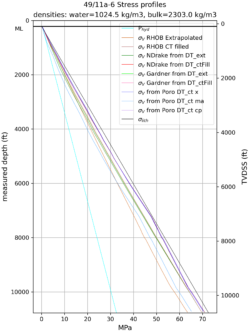
Vertical stress calculated from the different estimates of density for one of the Viking A wells